The purpose of the responses from parish councils and other interested
parties to the environmental section of the scoping report for Botley West
is not to object to nor to agree with the proposed development but to add
further considerations thought to be missing.
Tackley Parish Council considers that the following elements should be
included in the applicant’s environmental statement. Numbers in brackets
refer to points provided by the Stop Botley West campaign:
Impact on biodiversity. We note the opportunity to increase the natural
biodiversity of the land in Tackley parish that will be impacted by the
proposed development. Therefore, at the very least, we expect the
environmental statement to cover all elements of biodiversity; to set out
how the design of the proposed development provides an opportunity for an
increase in natural biodiversity; and to set out the measures that will be
put in place to ensure that this is achieved. We would expect the
environmental statement to consider the entirety of Natural Capital
Best Practice Guidance: Increasing Biodiversity at All Stages of a Solar
Farm’s Lifecycle, published by Solar Energy UK (formerly the Solar
Trade Association) in 2022, and to refer to the evidence provided to the
House of Commons Environmental Audit Committee regarding
Technological innovations and climate change: onshore solar
energy on 11 January 2023.
Impact on food security. Within a national context, the environmental
statement should consider the environmental impact of the off-shoring of
the equivalent acreage of food-producing farmland, including (i)
transportation of the equivalent tonnage from the most likely suppliers;
and (ii) the impact of the creation of new arable farmland (e.g. through
deforestation) to meet new production. Where it is considered that
mitigations to this are achieved through increased productivity in other
farmland within the UK, innovation, or changes in consumer habits, the
environmental statement should provide robust, credible, peer-reviewed
evidence of the achievability and economic reality of this.
The net benefit of the proposed development on carbon emissions. The
environmental statement should consider the level of embedded carbon in
the proposed development – i.e. the asset and the construction activity –
in particular providing robust evidence that the use of any imported solar
panels, instead of solar panels produced in the UK, is not significantly
detrimental to the carbon emissions abatement provided.
(10.2) Whether any protected, important or sensitive species of flora or
fauna that use areas on or around the site, e.g. for breeding, nesting,
foraging, resting, overwintering or migration, will be affected by the
project.
(12.1) Whether there any areas or features, designated or not, that may
have archaeological value on or around the location which could be
affected by the project.
(8.1) Whether there will be any risk of major accidents – including
those caused by climate change, in accordance with scientific knowledge –
during construction, operation or decommissioning.
(8.2) Whether the project will present a risk to the population – having
regard to population density – and their human health during construction,
operation or decommissioning; for example, due to water contamination or
air pollution.
(6.1) Whether the project will produce solid wastes during construction,
operation or decommissioning, and how these wastes will be handled or
disposed of.
(7.1) Whether the project will release pollutants or any hazardous,
toxic or noxious substances into the air.
(7.2) Whether the project will cause noise and vibration or the release
of light, heat, energy or electromagnetic radiation.
(7.3) Whether the project will lead to risks of contamination of land or
water from releases of pollutants onto the ground or into surface waters,
groundwater, coastal waters or the sea.
(13.1) Whether there are any routes on or around the location, used by
the public for access to recreation or other facilities, that could be
affected by the project.
This last point also gives rise to Tackley Parish Council to require the
environmental statement to specifically state if and how access to an
enjoyment of Dornford Lane will be impacted by the proposed development
throughout its lifecycle. While Dornford Lane is not within Tackley parish,
it is enjoyed by many of Tackley’s residents.
Tackley Parish Council has received a request from a parishioner to request
that the environmental statement also specifically consider the impact on
Long Mead meadow, a Local Wildlife Site near Eynsham. Again, while not in
Tackley parish, it is clearly of interest. We would expect the environmental
statement to consider this site specifically but also within the analysis
indicated in point 1 above.
Proposed Rail Bridge
Tackley Parish Council has sent the following letter of formal objection to
Network Rail:
We were told in 2019 at a meeting in Tackley Village Hall that the
village could have an underpass which would accommodate both horses and
pedestrians. The finances were available and this option was welcomed by
all residents at the meeting as well as your very own Mike Gallop, who
went on record in April 2020 with a press release saying “We thank the
community in Tackley for their support and look forward to working with
them on the permanent subway.”
Since then, the crossing has closed by way of a Temporary Traffic
Regulation Order and a temporary bridge has been installed. There is no
provision for horse riders. The residents were not happy about it, but
were assured that it was temporary only and permission was granted by the
highway authorities on the understanding that it was temporary. At this
point, the village was still under the impression that an underpass would
be built, however a potential alternative option was available to Network
Rail further north, the ‘Barwood Bridge’ option. To facilitate this
option, a portion of land was kept back by the landowner rather than being
developed for housing. The portion of land would accommodate a small car
park and a bridge over the rail cutting which could connect to both the
station and the public right of way via a new bridleway on the east side
of the line. The landowner on the east side of the line – Tackley Estate –
has recently reconfirmed their preference for this option to us.
In 2021 Network Rail informed us that a new study would be done to assess
the different options and we were told that the underpass was no longer
viable. While we were told that this was due to flooding issues, this
seemed odd as in 2001/2 Network Rail had planning permission to build an
underpass and flooding was not flagged up as a problem.
The new study also did not include the Barwood Bridge option.
During the whole consultation period over the last two years, not only
have we had numerous changes in Network Rail employees to deal with, it
has never felt like a consultation. No matter what is discussed, Network
Rail come back with the same footbridge option behind the houses on
Nethercote Road and a reroute of the bridleway.
The proposed bridleway introduces significant safety concerns and these
issues are being ignored. Local riders, the British Horse Society and the
landowner of the field – Tackley Estate – all say that this proposal is
dangerous. Given its length, the frequency and speed of trains and the
popularity of horse-riding in the local area, there would be a significant
risk of a horse bolting and injuring or killing multiple pedestrians. It
is possibly even more dangerous than the original level crossing that it
is intended to address. A resident was told at the consultation in the
village hall by Network Rail staff that any accidents which happened on
the bridleway would be the liability of the rider. We are now aware that
this is not true and Network Rail, as the landowner, would be liable.
We are also now being told that the current public right of way from the
station on the east side is to be closed. This route has been used by
residents for centuries if not millennia and is part of a very popular
circular route from the village, particularly during winter when other
paths are not accessible. It is also currently a key right of way to
access the station from Kirtlington.
The issue of crossing the line to get to the east platform and the public
right of way/bridleway need to be considered together, not separately, and
we request that the Barwood Bridge option is formerly examined and costed.
We understand that this will not be the cheapest option, but it is one
which solves the problem of the public right of way, providing safe
provision for horses and pedestrians, as well as station access with a
single bridge. As a village we must live with what is built forever and we
must have what most suits the village, not just the cheapest option for
Network Rail. In the grand scheme of your spending, it is a small price to
pay for you.
Gardiner Arms
Many of you will be aware that the Gardiner Arms pub closed on 25 June
and that a community group has been established
to purchase it. Because the Gardiner Arms is a listed asset of community
value, it cannot just be sold in a traditional manner; something called a
Section 95 notice outlines the requirement of a sale. Earlier in the
year a Section 95 notice was issued, and part of that requirement was
met by the parish council offering to bid on behalf of the community
group.
A representative of the parish council has recently met individually with
both parties involved in the sale of the Gardiner Arms to the community
group. The council wants to recognise and thank the Perrins for their hard
work over the last seven years serving the people of Tackley, supporting the
local community, and for ultimately offering the community the chance to
purchase the pub. We also want to thank Mr Gough for working hard to
establish the community group, and put the group in the best possible
position to purchase the pub.
To ensure the entire community is represented in the negotiations, the
council has agreed to join the community interest group and will be
represented by Councillor Angus Paxton.
Road Safety
The new vehicle-activated signs have been in for a couple of weeks now and
are working well.
Tackley will be in the next phase of the 20 mph rollout in the
district. Most villages in Oxfordshire will be moving to 20 mph limits
over the next year or so, as data shows that the number of life-changing
injuries and deaths from being hit by a car at 20 mph is vastly reduced
compared to 30 mph. With the increased population of Tackley and
corresponding increase in traffic, this will make our village safer for
pedestrians, cyclists and especially children.
On his death in November 1797, Sir John Whalley-Gardiner, 1st Baronet, of
Tackley left to his heirs and successors not only “certain messuages, lands
and tenements, situate in the parishes of Tackley, Cuddesdon, and Denton”,
but also an almighty legal mess. Litigation bedevilled his estate. Perhaps
that was not a surprise because Sir John was remembered for “drinking to
death five aldermen and Oxford tailors three”. Whether he did his drinking
in the pub in Tackley that now bears his name, the Gardiner Arms, is
unclear. What is clear is that the litigation was not resolved until a High
Court trial in February 1819. Despite few signs for optimism, I dare to hope
that the current impasse with the owners of the Gardiner Arms will be
resolved more quickly and more simply.
After that little bit of ancient history, let me turn to the recent history
of the Gardiner Arms and our group’s efforts to buy it for the village.
In my last article (Tackley Newsletter, June & July 2023) I said that we
would not despair at the lack of progress but would press on and remain
hopeful. Surely, a more constructive approach would be taken by the current
owners, Martin and Jackie Perrin? Sadly, that has not proved to be the case.
There has been little progress. This second article is to keep residents
informed about what has happened since and what our plans are.
Twice I offered to meet Martin to discuss our article in the last
Newsletter, but he did not accept. Perhaps he has written a response for
this edition? It would be good to know what his position is now.
We wrote to Martin and Jackie in late June telling them that we had
received the report of the specialist surveyor/valuer instructed by us. The
report had, of course, been written without the benefit of a full inspection
of the property because Martin and Jackie had declined to give
permission.
We told them that the report expressed serious concerns about the condition
of the pub and gave rise to anxiety about the cost of repairs. We said that
although we believed that it would be possible in due course to agree terms
with them for the purchase of the pub, we had concluded that it would be
premature to make an offer at that time. We explained that we were concerned
that to do so then might make the relationship between them and our group
even more problematic than it had been. We didn’t want that. We wanted to
have a better and more business-like relationship with them.
We pointed out that a key part of the problem about making an offer then
was that we did not know the extent of the structural and other repair
liabilities. Reluctant as we were to return to an issue which had proved
difficult in our earlier correspondence, we asked Martin and Jackie to
reconsider their position and to allow our surveyor to inspect the property
so that we were better informed about the pub’s condition and likely cost of
repairs. We said that we would then do our best to make a better offer than
was indicated by the report, with the aim of achieving an agreed price. We
expressed our hopes for an improved relationship with them.
There was no reply to the letter, which was delivered to the premises by
hand and also sent by email.
About 100 households replied to the questionnaire which we circulated with
the June edition of the Newsletter. The responses included these statistics
and comments:
88% said they think we need a village pub.
21% said they went to the Gardiner Arms weekly; 40% said they went there
now and again; and 28% said they never went.
In answer to the question ‘Why don’t you use the Gardiner Arms?’, the
responses were: poor food; erratic opening hours; poor management / the
landlord; poor ambience; dated appearance.
91% said they would like the Gardiner Arms to reopen as a community
pub.
The majority said that they would be interested in being part of the
cooperative, either as a shareholder or as a volunteer.
130 people attended our meeting in the village hall on 11 July to
learn what had – and had not – been happening, and to have a full discussion
about how to proceed. We invited Martin and Jackie, but regrettably they did
not attend. Many helpful contributions were made, and support for our
efforts was kindly expressed, but there was evident frustration at the
stance taken by Martin and Jackie.
Shortly after the meeting we wrote once more to Martin and Jackie. We also
wrote to Raymond Foulk, Jackie’s father, and Heston Holdings Ltd, the
company of which he is a director. That company owns the function room and a
large part of the car park as a result of the division of the site in
2018.
Among other things, our letter to the Perrins asked them to clarify their
position about the car park in the light of a recent change to the pub’s
website which now said that the pub had been offered to the village “with
large car park”. Were they now saying that they could sell us the car park,
with full access? We obviously needed to know their position because vehicle
access and parking will be essential for the successful running of the
pub.
Another recent change to the website now described the pub as being “in
good condition”, which surprised us, and we asked if they might now be
willing to allow our surveyor to inspect the premises.
Finally, we referred to the fact that they had said on more than one
occasion that they were not well disposed towards our group and would prefer
not to deal with it. We pointed out that we are simply representatives of
the village and that none of us acts in a personal capacity. Even if one or
more of us were to stand down, if Martin and Jackie really did want to sell
the pub to the village they would have to deal with other representatives of
the village, acting as a group on its behalf. We asked them to please put
such personal issues to one side and work together constructively to that
end.
There was no reply.
The letter to Mr Foulk and Heston Holdings Ltd asked:
If they were willing to negotiate for the sale of the function room and
car park as part of a package with the pub.
If they would permit access to our surveyor to inspect those parts which
the company owns.
At the date of writing this article, no response has been received.
On other fronts, we have asked Tackley Parish Council if they will help us
in our efforts to buy the pub. We expressed our concerns on two main points.
First, that such an important Asset of Community Value was proving so
difficult to buy for the village. Second, that a Grade II listed building
was in worrying condition. It was very evident that the council shared these
concerns, and we are pleased and grateful that it so readily agreed to do
what it can to assist. Councillor Angus Paxton has kindly offered to act as
our liaison with the council.
We have also turned our attention to West Oxfordshire District Council.
Councillor Tim Sumner kindly came to see us a few weeks ago and was very
supportive. Additionally, we have approached an officer of the council who
has responsibility for the relevant issues. We hope to have met him and
colleagues by the time this article is published. We intend to ask them to
focus on such issues as the condition of the pub and the fact that it has
now closed down. We believe that there are steps that the district council
can and should take to tackle the situation.
Aside from these issues, I need to make clear that a fundamental problem
which I wrote about in the previous article persists: namely, the price that
Martin and Jackie are asking for the pub. Only recently, they told an
intermediary who attempted to mediate between our group and them that the
price is £600,000 minimum. Any objective assessment shows that to
be a vastly inflated figure. To offer to sell something at a price which
bears no proper relationship to reality is not a genuine offer to sell.
Finally, to assist in keeping the village updated, there are two new places
where you can find information and documents about what we are doing. The
first is a new part of the main village website where you will find a
section under ‘Clubs and Groups’ for the Gardiner Arms Community Interest
Group. The second is on our dedicated website,
savetackleypub.org. We will
upload copies of correspondence, and there are also copies of the 2015
structural survey and the November 2015 valuation.
Editor’s note: when asked, Mr Perrin told me he would be uncomfortable
contributing an article, or a reply to the community interest group’s piece
in our June issue, to this edition of the Newsletter.
Conservation of Tackley Heath
Rachel Strachan & Katherine Woodrow
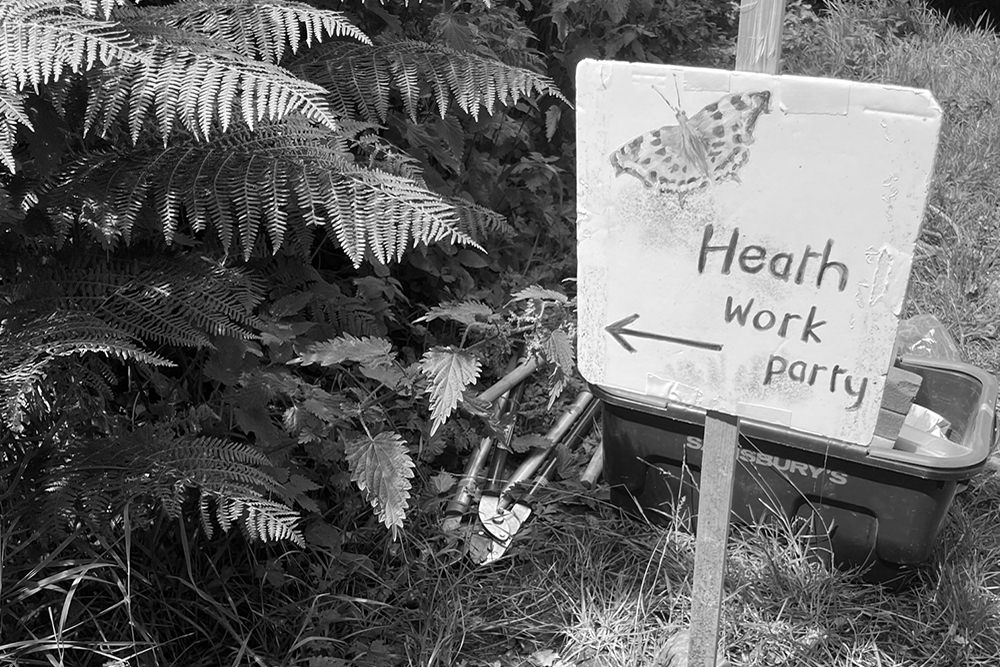
After a pause for the ground bird nesting season, we were back with a work
party in July. Ten wonderful volunteers did a sterling job fighting their
way though the bracken to clear the paths.
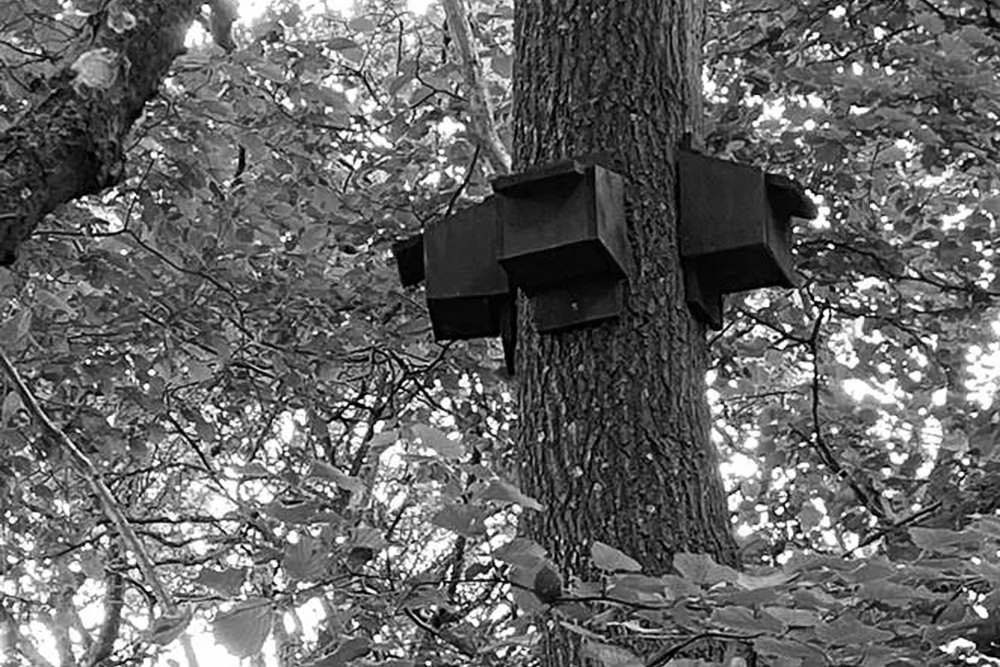
Two volunteers braved ladders to put up donated bird and bat boxes on trees
along the public footpath. The bird nesting boxes were made and donated by
the children of Tackley & Heyford Cubs. These will serve as roosting as well
as nesting sites, and the bat boxes will also serve for winter
hibernation.
Bat boxes
Other volunteers used various methods to bash down bracken along several
core paths, often working through dense foliage two to three metres high. A
prototype ‘bracken roller’ was trialled, heroically pulled by someone
mimicking a shire horse! Also trialled were wooden poles and rakes. The
results were good.
The paths that were worked on are now easier to see and walk along, with
several circuits through the heath now accessible. If you’ve recently been
put off by the height of the bracken, do please go and use the newly-cleared
paths — it will help keep them open.
The low, sparse bracken in the trial patch that the busy Cubs worked on,
during the growing seasons this year and last, demonstrates the impact of
more consistent bracken control.
We are delighted to welcome two new committee members, Dan and David. If
you are interested in joining the committee or volunteering for future work
parties, we would love to hear from you.
Please note that, this autumn, contractors for Scottish and Southern
Electricity Networks will be carrying out tree and vegetation clearance near
the power lines that cross the heath. This work is essential for the safety
and continuity of the network.
As summer approaches I love hearing about where people are going and what
they are looking forward to doing. The variety of places is fantastic — from
the spectacular scenery of the Norwegian fjords, to sunny beaches in the
Greek islands, to family activities at Butlin’s. Equally there is an
enormous range of things that people enjoy doing, from walking to reading,
exploring different cities and museums. John and I will be returning to the
Jura region of France for some more cycling and walking.
With any holiday the trick is to find the right balance of things, so that
when we arrive home we don’t “need another holiday to recover from the
holiday” but are in fact fully rested, reinvigorated and ready to go
forward.
The word holiday, from the 1500s – and earlier haliday,
c. 1200 – comes from Old English haligdæg, combining
halig (holy) with dæg (day). Definitions include: holy day;
consecrated day; religious anniversary; Sabbath. By the fourteenth century
it referred to both a religious festival and to a day of exemption from
labour and recreation.
Taking time to rest is very important; you may remember the parable of the
woodcutters from June’s article. Having created the world, God rested on the
seventh day, setting the example for us to follow and commanding us to
“Remember the Sabbath day by keeping it holy. Six days you shall labour and
do all your work, but the seventh day is a sabbath to the Lord your God. On
it you shall not do any work, neither you, nor your son or daughter, nor
your male or female servant, nor your animals, nor any foreigner residing in
your towns. For in six days the Lord made the heavens and the earth, the
sea, and all that is in them, but he rested on the seventh day. Therefore
the Lord blessed the Sabbath day and made it holy.” (Exodus 20:8–11).
What we actually do on holiday is important, so that we return fully rested
and reinvigorated. We can all fall into two unhelpful habits. First, as the
holiday approaches and things pile up, we often delay certain things – like
reading, or jobs around the house – until we are ‘on holiday’. But this only
fills our time off with non-work jobs; and we remain equally busy, doing
things rather than resting.
Second, we often carry with us the cultural pressure to always be available
for work, which equally prevents us from relaxing. To actually take time
off, without looking at emails or answering the phone, requires planning and
discipline.
Wherever you go and whatever you do, I wish you a wonderful, fun and
refreshing summer holiday.
We continue to hold coffee mornings in Tackley Methodist Church on
Thursdays between 10:30 am and 12 noon, so why not join us for a
drink, biscuits and a chat? We’ve also been known to eat cake! You can be
sure of a very warm welcome.
Thank you to all who donated items for our food bank boxes. These have now
been collected, and I know they’ll be gratefully received by those who are
finding things difficult at the moment.
As usual, Messy Church is taking a break during August.
The gardening year is sailing by and we are now looking forward to our
September meeting, when we will welcome Tim Walker and will be joined by
Steeple Aston Garden Club. If you missed Tim last time, do come along — he’s
very knowledgable and entertaining. This will be on Tuesday,
19 September — look out for posters.
On Tuesday, 17 October we have Hugh Warwick and his very interesting
talk on hedgehogs again.
In June we had a wonderful garden party combined with our farewell to Gill
Laurence’s husband, Geoffrey. She laid on a beautiful spread, and it ended
with a short firework display.
We meet at Tackley Village Hall at the times given to arrange transport to
the start of each walk. Walking is at the participant’s own risk.
Saturday, 12 August at 9:30 am: Charlbury, Fawler and
Stonesfield, 7 or 2½ miles. The route starts outside the Bell Inn,
Charlbury, and passes along the edge of Cornbury Park to Fawler and
Stonesfield. Then back to Charlbury via the Salt Way and Woodstock Way.
A shorter 2½-mile route returns along the Oxfordshire Way from Fawler
directly to Charlbury.
Wednesday, 23 August at 2 pm: Charlton-on-Otmoor,
4 miles. This circular walk starts in the village of
Charlton-on-Otmoor, taking us past Oddington and out onto Otmoor —
described as a ‘forgotten land’ and ‘sleeping Otmoor cast under a spell of
ancient magic’. The moor is a paradise for birdwatchers as many birds stop
here or pass through on their route from the Severn to the Wash. The walk
also takes in the military firing range!
Saturday, 9 September at 9:30 am: Adlestrop, Chastleton and
Cornwell, 5 miles. Adlestrop is where Edward Thomas stepped out of
the train and was so impressed by the peace and tranquillity that he wrote
the eponymous poem in 1917, before being killed in the war; Chastleton is
one of the finest, unspoilt Jacobean houses in the National Trust
portfolio; and Cornwell is a closed estate village. Pass through J. C.
Bamford’s farm on the way. There are no pubs on the route; and the teas in
St Mary’s Church, next door to Chastleton House, are only served from
1 pm when the house is open.
Wednesday, 27 September at 2 pm: villages of the Windrush
Valley: Asthall, Swinbrook, Fulbrook and Burford, 4 miles. A
fascinating walk in the Windrush Valley past ancient burial mounds, Norman
churches and manors. Beautiful villages hide interesting histories of
landowners and literary figures. Tea in Burford.
Our new programme of talks begins on Monday, 25 September at 7:45 for
8 pm in Tackley Village Memorial Hall when Bob Hessian will talk about
the rail disaster at Shipton-on-Cherwell on Christmas Eve 1874. Membership
is £12, due in September, or visitors are welcome for £5.
Elsie Wren Coles
Zachary Coles and Lucy Pike
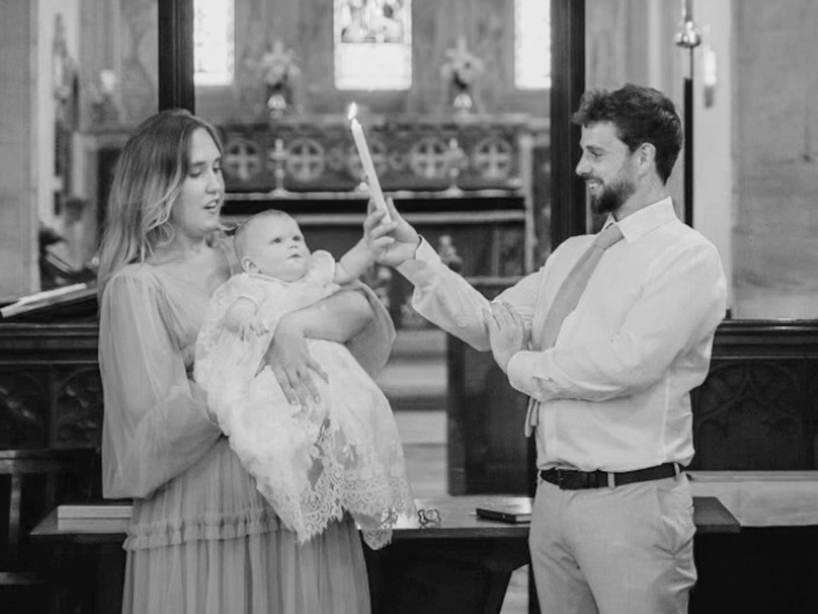
We were privileged to be at St Nicholas’ Church on 25 June to
celebrate the christening of our daughter Elsie. We would like to extend our
thanks to the Rev Harriet Orridge who delivered a beautiful service, and to
our friends and family who joined in the celebration. It was truly a magical
day.
John Perkins
Sue Whitaker-Perkins
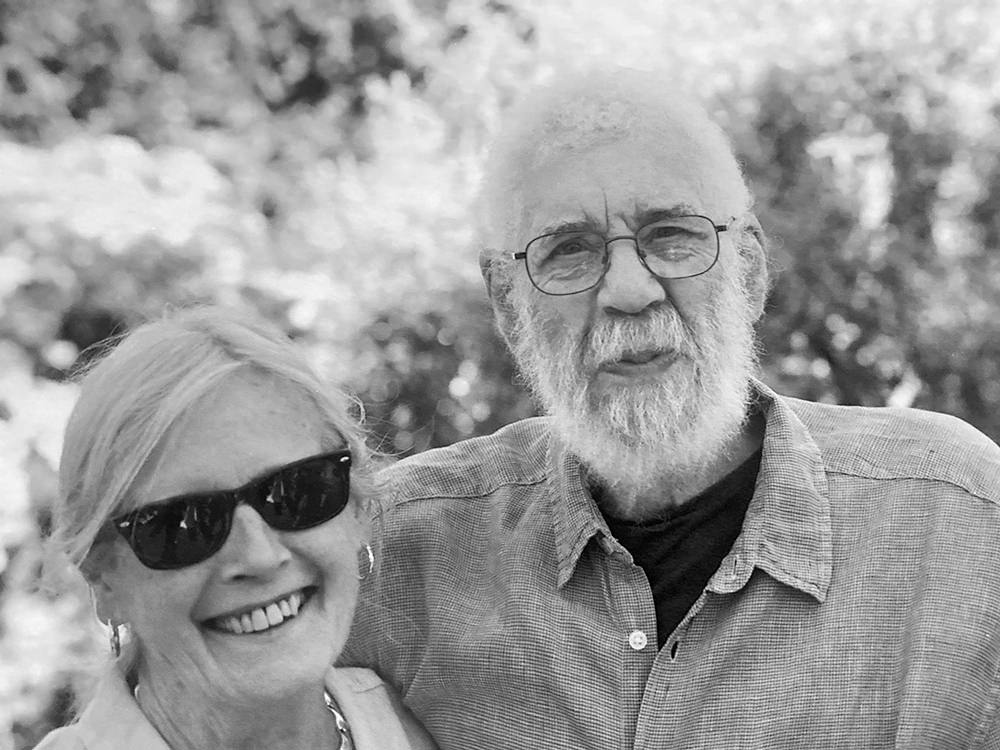
I was incredibly touched by how many of you came to John’s funeral and
joined us at Nether Barn afterwards. He will stay in Tackley’s memory for
many years to come — for everything he did to enhance the history group, but
also for his kindness and support to many young people in the village; a gap
that will be hard to fill. Thanks to all of you who have kindly donated in
his honour to Médecins Sans Frontières, a charity he supported for many
years. And thanks from me for your kindness and support. I miss my John.